
EdTech Branding & Marketing: Build a Scalable Education Brand
By Pavan Reddy Vuyyuru

Chapter 01: EdTech Doesn’t Sell Courses. It Sells Outcomes.
People don’t buy a course because they want videos, modules or certificates.
They buy because they want a better result.
What the learner really wants
| They Don’t Really Want | They Actually Want |
|---|---|
| A digital marketing course | A marketing job or better career |
| A coding course | To become a developer |
| An exam preparation course | To clear the exam |
| An MBA / executive program | A better role or promotion |
| A children’s learning program | Better performance and confidence |
The Simple Idea
Course = What you sell
Outcome = Why they buy
So instead of asking:
“How do we sell this course?”
Ask:
“What problem are we solving, and what result can we help the learner achieve?”
The EdTech Marketing Formula
Problem → Program → Learning → Outcome
The learner doesn’t buy the curriculum.
They buy the possibility of a better future.
Chapter 02: The Learner Is Not a Demographic. The Learner Is a Story.
| Learner A | Learner B |
|---|---|
| Final-year student | Working professional |
| Worried about placements | Wants to switch into technology |
| Needs confidence | Needs acceleration |
| Needs fundamentals | Needs advanced application |
Understand the Learner’s Story
Before marketing a program, ask:
01 — Where are they today?
Their current situation.
02 — Where do they want to go?
Their desired outcome.
03 — What have they already tried?
Courses, colleges, self-learning or other solutions.
04 — What are they afraid of?
Failure, money, time, career risk or falling behind.
05 — What is stopping them?
Time, confidence, knowledge, money or trust.
06 — Who influences their decision?
Parents, peers, managers, mentors or colleagues.
07 — What will make them believe you?
Proof, outcomes, testimonials, faculty or credentials.
The Question Behind Every Purchase
A learner isn’t only asking:
“Will I learn?”
They are also asking:
“What if I waste my money?”
That fear is often the real barrier to conversion.
Simple Principle
Don’t market to a demographic.
Understand the person’s situation, motivation and desired outcome.
Chapter 03: The Job-to-be-Done Is More Important Than the Course Name
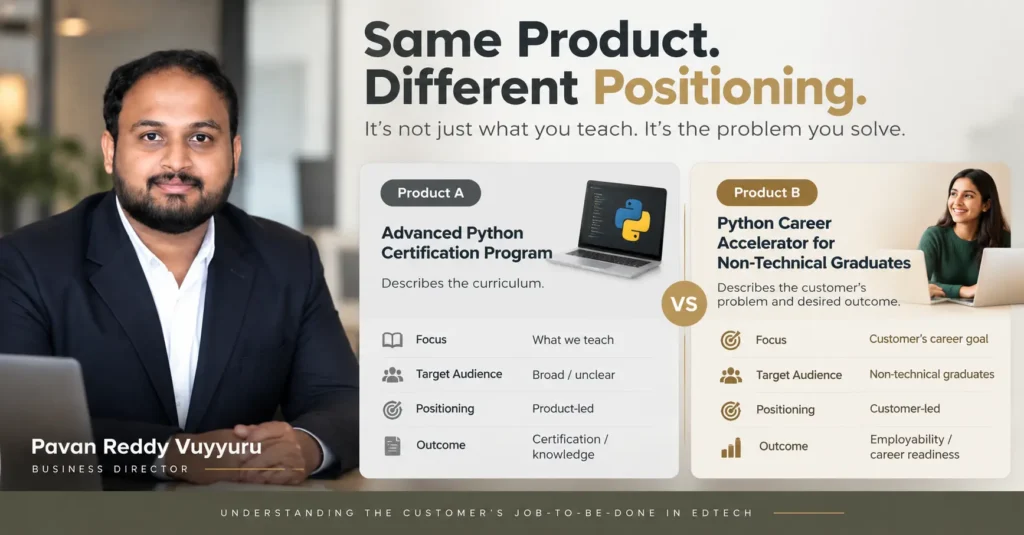
| Comparison | Product A | Product B |
|---|---|---|
| Product Statement | “Advanced Python Certification Program” | “Python Career Accelerator for Non-Technical Graduates” |
| What it describes | The curriculum / product | The customer’s problem and desired outcome |
| Focus | What the company teaches | What the customer wants to achieve |
| Target Audience | ❌ Broad / unclear | ✅ Non-technical graduates |
| Customer Problem | ❌ Not clearly addressed | ✅ “I need to build a career in tech.” |
| Customer Job-to-be-Done | ❌ Learn Python | ✅ Become employable as a developer |
| Positioning | ❌ Product-led | ✅ Customer-led |
| Marketing Message | “Learn advanced Python.” | “Build the skills you need to start a tech career.” |
| Differentiation | ❌ Easy to compare with hundreds of Python courses | ✅ Creates a specific category and audience |
| Sales Conversation | “Here is what our course contains.” | “Here is how we can solve your career problem.” |
| Outcome | Certification / knowledge | Career readiness / employability |
| Overall | Describes the product | Positions the product |
The perceived value changes depending on the job.
Chapter 04: Positioning — Why Should the Market Remember You?
In EdTech, many brands sound the same:
- Industry experts
- Practical learning
- Live classes
- Projects
- Certification
- Career support
When everyone says the same thing, nothing stands out.
Instead of saying:
“We provide quality education.”
Say:
“We are the platform for…”
| Positioning Example | Who It Is For |
|---|---|
| Platform for working professionals transitioning into technology | Career switchers |
| Platform for practical finance education | Finance learners |
| Platform built around outcome-based exam preparation | Exam aspirants |
| Platform that turns beginners into portfolio-ready designers | Aspiring designers |
Why Positioning Matters
Positioning → Marketing → Product → Sales → Content
It tells:
- Marketing what to communicate
- Product what to build
- Sales whom to target
- Content what to teach
- Leadership what opportunities to pursue or reject
The Simple Idea
Strong positioning isn’t about saying everything.
It’s about being remembered for something important.
Chapter 05: The Brand Is the Expectation Created Before the First Class
A brand is more than a logo, website or colour palette.
It is the expectation a learner has before experiencing your product.
What Should People Think When They Hear Your Name?
| Possible Brand Perception |
|---|
| Affordable |
| Premium |
| Career-focused |
| Practical |
| Academic |
| Innovative |
| Exam-oriented |
| Mentor-led |
| Beginner-friendly |
| Community-driven |
If the answer is:
“I don’t know. They offer many courses.”
There is a branding problem.
More Courses ≠ Stronger Brand
A large catalogue can create choice — but also confusion.
Your brand should make four things clear:
Who are you?
Who do you serve?
What are you exceptionally good at?
Why should people believe you?
The Simple Idea
A strong brand creates a clear expectation before the learner ever attends the first class.
Chapter 06: Trust Is the Real Currency of EdTech
The Trust Stack
| Credibility Factor | Key Question |
|---|---|
| Faculty Credibility | Who is teaching? |
| Curriculum Credibility | Why is this curriculum relevant? |
| Outcome Credibility | What happened to previous learners? |
| Institutional Credibility | Who is behind the company? |
| Social Proof | What are real learners saying? |
| Product Proof | Can I experience something before purchasing? |
| Transparency | What are you willing to disclose? |
The most powerful proof is often not the loudest.
A learner saying:
“I joined because of the advertisement”
is useful.
A learner saying:
“I was unemployed. I completed the program. Here is what I built. Here is where I work now.”
is powerful.
Proof beats promotion.
Chapter 07: The Trust Problem with Placement Marketing
Placement claims can strongly influence an EdTech purchase.
But there is a big difference between:
“Our students have achieved salaries of up to ₹25 LPA.”
and:
“We guarantee you a ₹25 LPA job.”
The first shares an outcome.
The second creates an expectation.
What Learners Should Know
- What placement assistance includes
- Who is eligible
- How the hiring process works
- What outcomes are realistic
- What the program can and cannot guarantee
The Simple Rule
Don’t promise what you cannot control.
A short-term claim may increase conversions today.
But honest marketing builds trust, reputation and brand value for years.
Chapter 08: The Course Is Not the Product
Many EdTech companies think:
Content = Product
It doesn’t.
A course can have excellent content and still deliver a poor experience.
What can go wrong?
- Confusing onboarding
- Unanswered doubts
- Unclear assignments
- No accountability
- Poor mobile experience
- No clear learning path
- Loss of motivation
So what is the real product?
The learning journey.
Discovery → Evaluation → Enrollment → Onboarding → Learning → Practice → Assessment → Application → Outcome → Advocacy
Every stage shapes the learner’s experience — and every experience shapes the brand.
Chapter 09: Design for Human Motivation, Not Just Content Delivery
Learners don’t always stop because the content is difficult.
Sometimes, life simply gets in the way.
A learner misses a class, falls behind and eventually stops logging in.
The problem isn’t always the learner.
The learning system should help them come back.
Design for Real Life
- Shorter learning units
- Smart reminders
- Progress recovery
- Mentor intervention
- Accountability
- Peer groups
- Milestone celebrations
- Personalised recommendations
The Simple Idea
Don’t ask:
“Why did the learner stop?”
Ask:
“How can we make it easier for the learner to return?”
Great EdTech doesn’t make learners feel guilty for falling behind.
It makes getting back on track easy.
Chapter 10: The First 7 Days Can Determine the Relationship
The first few days after enrollment are critical.
A learner should quickly understand:
- What happens next
- Where to start
- How much time to spend
- Who their instructor is
- How to ask questions
- How to track progress
- What their first milestone is
- What success looks like
Two Different Experiences
| Experience A — Product-Centric | Experience B — Customer-Centric |
|---|---|
| “Welcome to the course.” | “Welcome. Here’s your 30-day roadmap.” |
| Dashboard with 87 modules | Day 1: Watch this |
| “Good luck.” | Day 2: Complete this |
| ❌ Figure it out yourself | Day 3: Meet your mentor |
| ❌ Information overload | Day 7: Complete your first milestone |
| ❌ No clear journey | ✅ Clear learning journey |
| ❌ Passive onboarding | ✅ Guided onboarding |
| Sells access to content | Designs the learning experience |
The Key Insight
The second platform may not teach different content.
It simply manages the learner’s journey and motivation better.
Good onboarding doesn’t just welcome learners.
It gives them a clear reason to keep going.
Chapter 11: Marketing Should Begin Before the Course Exists
One common mistake in EdTech is:
Build the course → Launch it → Ask marketing to sell it.
A better approach is:
Understand the market → Identify the need → Build the course → Launch it.
What Should You Study First?
- Search behaviour
- Learner conversations
- Competitor offerings
- Job descriptions
- Industry requirements
- Employer expectations
- Student objections
- Price sensitivity
- Emerging skills
The Key Idea
Marketing should not simply promote what the product team created.
It should help answer:
“What product should we build in the first place?”
The best EdTech products are built from market demand, not assumptions.
Chapter 12: Build the Curriculum Around the Market, Not the Instructor
An instructor may think:
“What do I know?”
The learner asks:
“What do I need?”
These are not always the same.
A 15-year expert may want to teach 40 concepts. but, The learner may only need 12 to become capable.
Every Module Should Answer
| Question | Purpose |
|---|---|
| Why does this matter? | Relevance |
| Where will I use it? | Application |
| What will I be able to do? | Capability |
| How can I prove it? | Evidence |
The Key Idea
Don’t measure a curriculum by how much it teaches. Measure it by what the learner can actually do.
Knowledge creates awareness. Application creates capability.
Chapter 13: Projects Are the Bridge Between Learning and Employability
One of the strongest marketing claims an EdTech platform can make is not:
“We have 100 hours of content.”
It is:
“Here is what our learners actually built.”
A portfolio communicates ability.
| Technology | Marketing | Design | Business |
|---|---|---|---|
| Applications | Campaigns | Case Studies | Market Studies |
| Dashboards | Strategies | Interfaces | Financial Models |
| APIs | Analytics | Prototypes | Strategic Plans |
| AI Projects | Brand Plans | — | — |
A certificate says:
“I completed something.”
A portfolio says:
“I can do something.”
The second has greater commercial value.
Chapter 14: The Instructor Is a Brand
In EdTech, instructors are not just content providers.
A strong instructor can become:
- Educator
- Creator
- Community Leader
- Industry Voice
- Trust Builder
- Acquisition Channel
Learners may discover the instructor first and the platform later.
The Instructor-Led Growth Loop
Instructor → Audience → Trust → Platform Discovery → Enrollment
A strong instructor brand can therefore become one of the most powerful organic growth engines for an EdTech company.
Chapter 15: Content Marketing — Teach Before You Sell
If every post says:
“Enroll Now.”
People eventually stop paying attention.
Instead, teach something useful first.
| Traditional Promotion | Problem-Led Content |
|---|---|
| “Join our data analytics course.” | “We analysed 50 entry-level analytics jobs. Here are the five skills appearing repeatedly.” |
| “Learn digital marketing.” | “Why your Meta campaign may generate leads but no sales.” |
| “Learn AI.” | “Five tasks every marketing manager should automate before hiring another executive.” |
The Simple Idea
Teach → Build Trust → Demonstrate Expertise → Create Demand
Good content answers the learner’s questions before they even ask.
Don’t just promote the course.
Prove that you know the problem you’re solving.
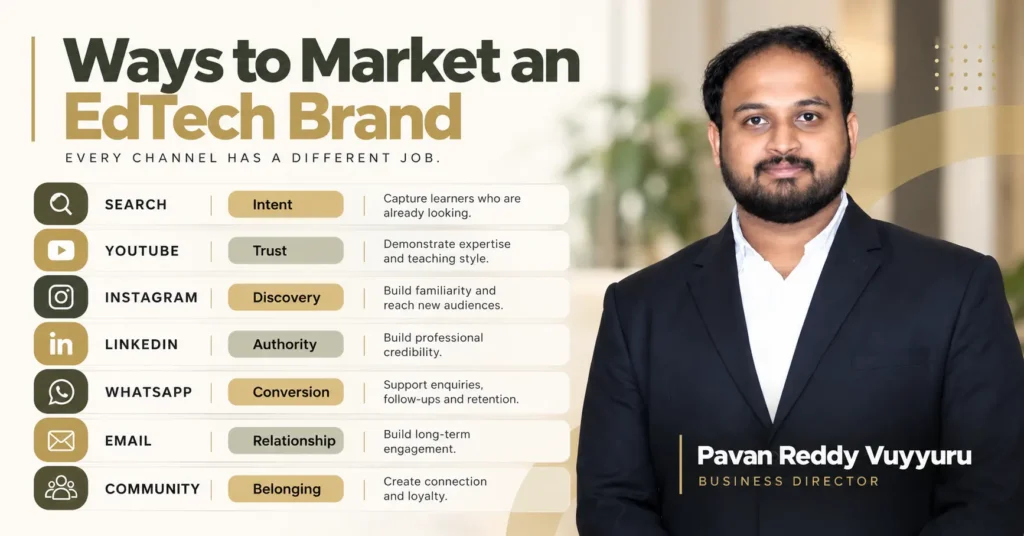
Chapter 16: YouTube, Search and Social Media Play Different Roles
The mistake is posting the same content everywhere.
| Channel | Role | Purpose |
|---|---|---|
| Search | Intent | Capture learners who are already looking |
| YouTube | Trust | Demonstrate expertise and teaching style |
| Discovery | Build familiarity and reach new audiences | |
| Authority | Build professional credibility | |
| Conversion | Support enquiries, follow-ups and retention | |
| Relationship | Build long-term engagement | |
| Community | Belonging | Create connection and loyalty |
Chapter 17: The Website Should Answer the Buyer’s Internal Questions
What the learner wants to know
| Question | What They Need to Understand |
|---|---|
| Is this for me? | Target learner |
| What will I learn? | Curriculum |
| Who teaches it? | Faculty credibility |
| How difficult is it? | Learning level |
| How long will it take? | Time commitment |
| What will I achieve? | Expected outcome |
| How much does it cost? | Pricing |
| What support do I get? | Mentorship & support |
| What if I miss a class? | Flexibility |
| Can I try it first? | Demo / trial |
| What do learners say? | Reviews & testimonials |
| What outcomes are realistic? | Proof & transparency |
The Simple Idea
A good website doesn’t just present information.
It removes doubt.
When the website answers the buyer’s questions clearly, the sales conversation becomes much easier.
Chapter 18: The Free Experience Is Not a Giveaway. It Is a Sales Asset.
A free class should do more than give away information.
It should let learners experience the product.
What Should the Free Experience Show?
- Teaching quality
- Instructor personality
- Learning methodology
- Platform experience
- Community
- Outcome-focused learning
The Goal
Make the learner think:
“If the free experience is this good, the paid program may be worth it.”
The best free experience doesn’t just teach.
It builds trust and makes the value of the paid program easier to understand.
Chapter 19: Counselling Should Help People Decide, Not Pressure Them to Buy
EdTech counselling should not be about closing every lead.
It should be about finding the right program for the right learner.
A Good Counsellor Understands
- Learner’s background
- Career objective
- Prior knowledge
- Readiness
- Time commitment
- Affordability
- Expectations
The Right Approach
Understand → Assess → Recommend → Guide
Sometimes the right answer is:
“You should start with our foundation program.”
Sometimes:
“You don’t need this advanced course.”
That honesty may lose a sale today.
But it can build trust, referrals and repeat business tomorrow.
Good counselling doesn’t push people into buying.
It helps them make the right decision.
Chapter 20: The Sales Funnel Is a Diagnostic System
A funnel doesn’t just show how many people buy.
It shows where the business is losing people.
Example Funnel
50,000 Leads → 20,000 Reachable → 8,000 Qualified → 3,000 Demos → 1,500 Counselling Calls → 500 Enrollments
Instead of simply saying:
“Sales is weak.”
Ask:
- Why did 30,000 leads disappear?
- Why did only 8,000 qualify?
- Why did many qualified learners miss the demo?
- Why did only 500 enroll?
Who Owns What?
| Function | Role |
|---|---|
| Marketing | Creates the funnel |
| Product | Makes the promise believable |
| Sales | Makes the decision comfortable |
| Analytics | Identifies where the funnel is leaking |
Chapter 21: Discounts Are Not a Strategy
Constant discounts can train customers to wait for a better price.
₹80,000 → ₹19,999 → ₹14,999 → ₹9,999
Over time, the original price loses credibility.
The brand starts communicating:
“The product is only valuable when it is discounted.”
Better Ways to Create Value
- Clear program tiers
- Flexible financing
- Transparent scholarships
- Early-bird cohorts
- Bundles
- Corporate pricing
- Alumni benefits
The Simple Idea
Price should reflect value, not create artificial urgency.
Build a product people are willing to pay for — instead of training them to wait for discounts.
Chapter 22: The Real Asset Is the Learner Database
A learner database is more than a list of names and email addresses.
It tells you what learners do, what they need and what they may want next.
What You Can Understand
- What they searched for
- What content they consumed
- What courses they viewed
- What webinars they attended
- What they purchased
- Where they dropped off
- What they completed
- What questions they asked
- What they may need next
Turn One Learner Into a Long-Term Relationship
Digital Marketing Fundamentals
→ Performance Marketing
→ Marketing Analytics
→ AI for Marketing
→ Leadership for Marketing Managers
This is lifecycle marketing.
The Simple Idea
Don’t think of a learner as a one-time transaction.
One learner can become a multi-year customer, advocate and part of your community.
Chapter 23: Retention Is Marketing
In EdTech, getting a learner to enroll is only the beginning.
What happens after enrollment can shape the brand, revenue and reputation.
| Learner Outcome | Business Impact |
|---|---|
| Completes the program | Testimonial |
| Referral | |
| Alumni member | |
| Repeat customer | |
| Community leader | |
| Content creator | |
| Drops out | Refund |
| Complaint | |
| Negative review | |
| Lost referral | |
| Reputation risk |
The Simple Idea
Retention isn’t just a product metric.
It is a marketing metric.
A learner who succeeds can help bring the next learner.
Better retention → Better outcomes → More proof → More trust → More growth
Chapter 24: Completion Is the Hidden Brand Metric
| Platform A | Platform B |
|---|---|
| 100,000 enrollments | 50,000 enrollments |
| Higher volume | Lower volume |
| ❌ Weaker completion & learner outcomes | ✅ Stronger completion & learner outcomes |
| More learners entering the funnel | More learners successfully reaching outcomes |
| Less evidence of transformation | Stronger evidence of transformation |
| Brand advantage: Volume | Brand advantage: Outcomes |
The Brand Flywheel
Successful Learners → Evidence → Trust → Better Conversion → Better Economics → More Product Investment → Better Learner Outcomes → More Successful Learners
Ultimately, Platform B can build the stronger brand — because outcomes create evidence, and evidence creates trust.
Chapter 25: Outcomes Are the Most Powerful Marketing Content
The strongest content an EdTech company can produce is not necessarily an advertisement.
It is a genuine learner outcome. Document them.
Show the journey.
| Before | During | After | Evidence |
|---|---|---|---|
| Where were they? | What did they struggle with? | What changed? | What can be proven? |
Chapter 26: Community Can Become Your Competitive Moat
Courses can be copied.
Videos can be copied.
Features can be copied.
Pricing can be copied.
Community is much harder to copy.
A strong EdTech community can bring together:
- Peers
- Mentors
- Alumni
- Study groups
- Industry professionals
- Project collaborators
- Job opportunities
- Discussions
The platform becomes more than a content library.
It becomes an ecosystem where learners belong, connect and grow.
The Simple Idea
Content attracts learners.
Community keeps them connected.
A strong community can improve:
Engagement → Retention → Referrals → Brand Affinity
Chapter 27: Corporate Learning Is a Different Business
B2C EdTech asks:
“Will the learner buy?”
B2B EdTech asks:
“Will this training improve our people and business?”
The Buyer and Learner May Be Different
| Buyer | Learner |
|---|---|
| HR | Engineers |
| L&D | Sales Teams |
| Business Leaders | Managers |
| Department Heads | Analysts |
| Founders | Executives |
So corporate marketing must prove business value, not just course quality.
What Should Be Demonstrated?
- Skill gaps
- Learning objectives
- Adoption
- Completion
- Assessment
- Capability improvement
- Manager feedback
- Business relevance
The Simple Idea
B2C sells learning outcomes to individuals.
B2B sells business outcomes to organisations.
Chapter 28: B2B EdTech Should Sell Capability, Not Hours
A company doesn’t really want:
“40 hours of training.”
It wants:
- Better salespeople
- Better managers
- Better analysts
- Faster onboarding
- Stronger technical teams
- Reduced skill gaps
The Shift
Training Hours → Business Capability
Corporate buyers care less about how long people learn and more about what they can do after learning.
The Simple Idea
Don’t sell hours of training.
Sell the capability those hours create.
Chapter 29: AI Is Not the Product. It Is a Lever.
Every EdTech company can say:
“AI-powered learning.”
The real question is:
Where does AI create a measurable improvement in the learner’s experience or outcome?
Where AI Can Create Value
| AI Application | What It Improves |
|---|---|
| Personalisation | Creates different learning paths based on learner needs. |
| Assessment | Identifies knowledge gaps and learning difficulties. |
| Tutoring | Provides instant explanations and support. |
| Content | Adapts learning material to different levels. |
| Translation | Makes education accessible across languages. |
| Practice | Creates simulations and real-world practice environments. |
| Career | Identifies skill gaps and recommends career paths. |
| Operations | Automates repetitive support, analysis and administration. |
The Important Shift
AI Feature → Learner Problem → Measurable Improvement
For example:
AI Tutor → Learner gets stuck → Immediate guidance → Less drop-off
AI Assessment → Knowledge gap identified → Personalised practice → Better performance
AI Career Engine → Skill gap identified → Targeted learning → Better employability
The technology itself is not the value.
The improvement it creates is the value.
Key Idea
Don’t market AI because it is AI. Use AI where it makes learning more personalised, accessible, effective, measurable or scalable.
AI should solve a learner problem — not decorate a pitch deck.
Chapter 30: AI Can Also Destroy Trust If Used Carelessly
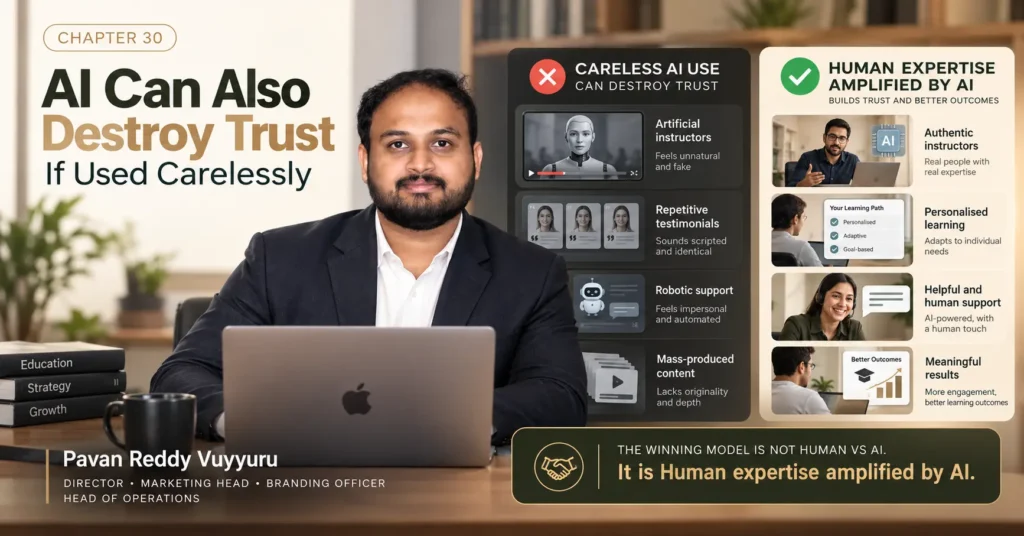
AI can increase speed and scale. But in EdTech, trust is still deeply human.
Learners notice when:
- An instructor feels artificial.
- Testimonials sound scripted or identical.
- Support responses feel robotic.
- Course content feels mass-produced.
- Communication lacks empathy.
The Better Model
| AI Strength | Human Strength |
|---|---|
| Scale | Empathy |
| Speed | Experience |
| Personalisation | Mentorship |
| Automation | Judgment |
| Data analysis | Credibility |
| 24/7 support | Human connection |
Human Expertise → AI Amplification → Better Learner Experience → Better Outcomes
Key Idea
Use AI to make great education stronger, not to make human education disappear.
AI can scale education. Human credibility makes people trust it.
Chapter 31: Data Should Tell You What the Learner Is Not Saying
Analytics often tells you what happened:
- Clicks
- Views
- Sessions
- Conversions
- Completion rates
But great analytics should help you understand why it happened.
Suppose thousands of learners repeatedly stop at Module 7.
Don’t just record the drop-off. Investigate it.
| What the Data Shows | What It Could Mean |
|---|---|
| Learners stop at Module 7 | Content may suddenly become difficult |
| Completion drops sharply | Assignments may be too complex |
| Video watch time falls | Content or delivery may be weak |
| Learners repeatedly ask the same question | Prerequisite knowledge may be missing |
| One instructor has unusually high completion | Their teaching approach may be working better |
The data is essentially saying:
“Something is happening here. Find out why.”
From Measurement to Understanding
Data → Pattern → Question → Insight → Action → Improvement
Key Idea
The most valuable data doesn’t just tell you what learners did. It helps you understand what they were struggling to say.
Chapter 32: The Real Competitor May Not Be Another EdTech Company
EdTech companies often look at other EdTech companies and call them competitors.
But the learner has many other choices.
| Alternative | Why Learners Choose It |
|---|---|
| YouTube | Free knowledge |
| Self-Learning | Flexibility and low cost |
| College Degree | Credential and recognition |
| Local Institute | Personal support and affordability |
| Mentor | Guidance and accountability |
| Doing Nothing | No cost and no commitment |
So competitive analysis should ask:
“What alternative does the learner have?”
Not just:
“Which EdTech companies compete with us?”
The Real Value of Paid Education
A paid EdTech product must provide value beyond content:
Content → Structure → Mentorship → Accountability → Practice → Assessment → Community → Career Support → Outcome
That’s where the real value is created.
Key Idea
Don’t compete only on content. Compete on the complete transformation.
Chapter 33: The Brand Experience Must Match the Price
A premium program cannot feel like a budget product.
If you’re charging ₹1 lakh or more, every part of the experience contributes to whether the learner feels the price is justified.
| Experience | What the Learner Should Feel |
|---|---|
| Website | Credible and premium |
| Counselling | Professional and consultative |
| Faculty | Experienced and trustworthy |
| Onboarding | Clear and well-designed |
| Learning Platform | Reliable and easy to use |
| Communication | Thoughtful and relevant |
| Support | Responsive and helpful |
| Certificate | Meaningful and credible |
The learner should never think:
“Why does this cost so much?”
Instead, they should feel:
“I understand why this costs what it costs.”
The Price–Experience Equation
Higher Price → Higher Expectation → Better Experience → Stronger Perceived Value
If the experience matches the promise, price feels justified.
Key Idea
Price creates an expectation. Experience either validates it or destroys it.
Premium pricing is not created by charging more. It is created by delivering an experience worthy of the price.
Chapter 34: Events Can Create Demand That Ads Cannot
Events That Build Demand
| Event Type | What It Can Create |
|---|---|
| Industry Masterclass | Expertise and authority |
| Career Transition Session | Aspiration and demand |
| Faculty Session | Trust and credibility |
| Employer Panel | Industry connection |
| Alumni Night | Social proof |
| Project Showcase | Proof of capability |
| Hackathon | Engagement and talent discovery |
| Demo Day | Visibility and outcomes |
| Career Fair | Employer relationships |
| Executive Roundtable | Leadership and partnerships |
A strong event can create:
Authority → Community → Trust → Relationships → Content → Demand
One successful event can become:
- Social media content
- YouTube videos
- Learner testimonials
- Alumni stories
- Faculty content
- PR opportunities
- Case studies
- Future event registrations
- Sales conversations
Key Idea
Ads can buy attention. Events can create relationships.
They create experiences that generate demand long after the event is over.
Chapter 35: Alumni Are Not the End of the Customer Journey
A learner completing a course should not disappear from the database.
They should enter the alumni ecosystem.
Imagine:
Learner → Graduate → Alumni → Community Member → Referral Source → Mentor → Advanced Program Customer → Brand Ambassador
The relationship can last years.
The strongest education brands understand that:
Graduation is not the end of the relationship. It is the beginning of the next one.
Chapter 36: The Lost Learner Is a Source of Intelligence
Thousands of people may enquire but never enroll.
Most companies simply mark them as:
“Lost.”
But a lost learner can contain valuable information.
Ask Why They Didn’t Enroll
| Reason | What It May Reveal |
|---|---|
| Price | Pricing or perceived value problem |
| Timing | Scheduling or urgency problem |
| Trust | Brand or credibility gap |
| Faculty | Instructor positioning issue |
| Location | Delivery model limitation |
| Course Duration | Product design issue |
| Competitor | Positioning or differentiation gap |
| Family Objection | Decision-making barrier |
| Lack of Urgency | Weak demand creation |
| Unclear Outcome | Value proposition problem |
| Poor Counselling | Sales experience problem |
The important part is not one lost learner.
It is the pattern across thousands of lost learners.
For example, if 30% repeatedly say:
“I don’t understand what I’ll actually get after completing the program.”
Then the problem may not be sales.
The value proposition is unclear.
Turn Losses Into Learning
Lost Learners → Collect Reasons → Identify Patterns → Find Root Cause → Improve Product/Marketing/Sales → Recover Future Conversions
Key Idea
Don’t just count who you lost. Understand why you lost them.
Every lost learner can reveal something that makes the next conversion easier.
Chapter 37: Marketing and Product Must Sit at the Same Table
The traditional organisational model looks like this:
Product Builds → Marketing Promotes → Sales Sells → Support Handles Complaints
The problem?
Each team sees only one part of the learner journey.
The Better Model
Customer Insight → Product → Marketing → Sales → Learning → Support → Outcomes → Customer Insight
It becomes a continuous loop.
| Team | Should Understand |
|---|---|
| Marketing | Why learners enquire, hesitate and drop out |
| Product | Why prospects don’t buy and where learners struggle |
| Sales | What learners value, fear and expect |
| Learning Team | Where learners lose motivation or need support |
| Support | What repeatedly creates frustration |
| Leadership | How all these signals affect business outcomes |
When these teams share information, the organisation can improve faster.
The Growth Loop
Customer Insight → Better Product → Better Marketing → Better Sales → Better Learning → Better Outcomes → More Customer Insight
The goal is not for every department to work harder.
The goal is for every department to learn from the same customer.
Key Idea
Marketing should not sit outside the product. Product should not sit outside the market.
The strongest EdTech companies don’t operate in departments. They operate around the learner.
Chapter 38: Unit Economics — The Business Behind the Brand
A beautiful EdTech brand can attract attention.
But attention does not automatically create profit.
Consider a program priced at ₹50,000:
| Cost | Amount |
|---|---|
| Course Price | ₹50,000 |
| Customer Acquisition | ₹15,000 |
| Sales Cost | ₹5,000 |
| Faculty Delivery | ₹8,000 |
| Technology | ₹3,000 |
| Support | ₹4,000 |
| Refunds & Incentives | ₹5,000 |
| Remaining Contribution | ₹10,000 |
That ₹10,000 is what remains before considering other overheads and costs not included above.
This is why marketing cannot operate independently of finance.
The Numbers Marketing Must Understand
CAC → Conversion → Revenue → Contribution → Retention → LTV
Marketing should not celebrate a campaign simply because it generated more leads.
The real questions are:
- How much did it cost to acquire a learner?
- How many leads actually converted?
- How much revenue did they generate?
- How much contribution remained?
- Did they complete and stay engaged?
- Will they buy again or refer others?
- What is their long-term value?
The Real Growth Question
Not:
“Can we acquire more learners?”
But:
“Can we acquire the right learners profitably and deliver enough value to retain them?”
Key Idea
Revenue creates growth. Healthy unit economics make that growth sustainable.
A strong EdTech brand doesn’t just attract learners. It creates a business model that can afford to serve them well.
Chapter 39: Scale Does Not Fix a Broken Business Model
Scaling a business sounds like success.
But scaling a broken experience simply multiplies the problems.
A campaign performs well:
More Budget → More Leads → More Sales → More Learners
Everyone celebrates.
Then the problems appear:
| Growth | What Can Go Wrong |
|---|---|
| More learners | Support gets overloaded |
| More classes | Learning quality declines |
| More students | Mentors become unavailable |
| More volume | Complaints increase |
| Lower attention | Completion declines |
| Poor experience | Refunds increase |
| More complaints | Reviews deteriorate |
The company has scaled acquisition faster than experience.
Scale the Whole System
Marketing Capacity → Sales Capacity → Delivery Capacity → Mentor Capacity → Support Capacity → Outcome Capacity
Growth should happen only when the entire system can handle it.
Before increasing acquisition, ask:
“If tomorrow we receive 10× more learners, can we maintain the same quality of experience?”
If the answer is no, the solution isn’t more marketing.
Fix the system first.
Key Idea
Growth should be proportional to delivery capability.
Don’t scale demand faster than you can deliver the experience that created the demand.
Chapter 40: The EdTech Brand Flywheel
A mature EdTech business doesn’t grow only by spending more on advertising.
It creates a self-reinforcing cycle where better products create better outcomes, and better outcomes create stronger growth.
The EdTech Growth Flywheel
Better Product → Better Learning Experience → Higher Completion → Better Outcomes → Better Testimonials → Stronger Reputation → Higher Trust → Better Conversion → Lower Effective Acquisition Cost → More Investment in Product → Better Product
And the cycle continues.
Why This Matters
At the beginning, a company may depend heavily on paid acquisition:
Spend More → Reach More → Acquire More
But a stronger brand gradually creates:
Better Outcomes → More Proof → More Trust → More Conversion → Lower Acquisition Cost
The business becomes less dependent on simply buying attention.
The Compounding Effect
| Improvement | Business Impact |
|---|---|
| Better Product | Better learner experience |
| Higher Completion | More successful learners |
| Better Outcomes | Stronger proof |
| Stronger Proof | Higher trust |
| Higher Trust | Better conversion |
| Better Conversion | Lower effective CAC |
| Lower CAC | More room to invest |
| More Investment | Better product |
Key Idea
The strongest EdTech brands don’t continuously buy attention. They compound trust.
Build a product that creates outcomes. Outcomes create proof. Proof creates trust. Trust creates growth. And growth gives you the ability to build an even better product.
Chapter 41: The CEO’s Job Is Not to Build an EdTech Company. It Is to Build a Learning Company.
Technology changes.
Algorithms change.
Advertising platforms change.
Course formats change.
AI changes the economics.
But one question remains:
Are learners becoming better because your company exists?
If yes, the business has a strong foundation.
If no, marketing can only postpone the problem.
The Five Questions Every CEO Should Watch
| # | Business Question | What It Reveals |
|---|---|---|
| 01 | Learner Acquisition | Are the right people discovering us? |
| 02 | Learner Conversion | Do they trust us enough to enroll? |
| 03 | Learner Engagement | Are they actually learning? |
| 04 | Learner Outcomes | Are they becoming better? |
| 05 | Learner Advocacy | Would they recommend us? |
These five questions connect the entire business:
Discovery → Trust → Learning → Outcome → Advocacy
Follower counts, impressions and website traffic can show activity.
But these five metrics show whether the learning business is actually working.
The CEO’s Real Responsibility
A CEO shouldn’t simply ask:
“How many learners did we acquire?”
The deeper question is:
“How much better are our learners because we exist?”
Key Idea
Build a company that improves learners’ lives, not simply a company that sells education.
Technology may change the way education is delivered. But learner transformation is what ultimately builds the business.
Chapter 42: The 90-Day EdTech Growth Audit
Before spending another ₹1 crore on marketing, audit the business first.
The goal is not to create another marketing plan.
The goal is to identify where the business is leaking value.
The 90-Day Audit Calendar
| Days | Focus Area | What to Audit | Key Outcome |
|---|---|---|---|
| 01–15 | 🟫 Brand | Positioning, reputation, messaging, competitors, reviews, website, social presence | Identify brand gaps |
| 16–30 | 🟩 Product | Onboarding, curriculum, faculty, learning experience, assignments, support, completion | Identify experience gaps |
| 31–45 | 🟦 Marketing | Acquisition channels, CAC, content, SEO, paid media, lead quality | Identify acquisition gaps |
| 46–60 | 🟨 Sales | Counselling, scripts, follow-up, objections, conversion, lost leads | Identify conversion gaps |
| 61–75 | 🟧 Retention | Engagement, drop-offs, completion, refunds, learner satisfaction | Identify retention gaps |
| 76–90 | 🟪 Growth | Positioning, content engine, referrals, lifecycle marketing, AI, acquisition channels, product improvements | Build the growth roadmap |
The 6-Phase Calendar
Days 01–15
Brand Audit
Positioning → Reputation → Messaging → Competitors → Reviews → Website → Social
↓
Days 16–30
Product Audit
Onboarding → Curriculum → Faculty → Learning → Assignments → Support → Completion
↓
Days 31–45
Marketing Audit
Channels → CAC → Content → SEO → Paid Media → Lead Quality
↓
Days 46–60
Sales Audit
Counselling → Scripts → Follow-up → Objections → Conversion → Lost Leads
↓
Days 61–75
Retention Audit
Engagement → Drop-offs → Completion → Refunds → Satisfaction
↓
Days 76–90
Growth Roadmap
Positioning → Content → Referrals → Lifecycle → AI → Acquisition → Product
The Final Question
At the end of 90 days, leadership should know:
Where are we losing customers?
Why are we losing them?
What is costing us money?
What is weakening the brand?
What should we fix first?
Where should we invest next?
Key Idea
Don’t spend more money to accelerate a leaking business. Find the leaks first.
Audit → Diagnose → Fix → Improve → Scale.
Chapter 43: The EdTech CEO Dashboard
A mature EdTech dashboard should show more than revenue.
Revenue tells you what happened.
A CEO dashboard should help explain why it happened and what is likely to happen next.
The CEO Dashboard
| Area | Key Metrics | What It Tells Leadership |
|---|---|---|
| 🟫 Brand | Brand searches, direct traffic, organic growth, reputation, share of voice | Are we becoming stronger in the market? |
| 🟦 Acquisition | Leads, qualified leads, CAC, channel performance | Are we attracting the right learners efficiently? |
| 🟩 Sales | Conversion rate, counselling conversion, revenue, average order value | Are prospects becoming customers? |
| 🟨 Product | Activation, engagement, course progress, completion | Are learners actually using and completing the product? |
| 🟧 Learner | Satisfaction, refunds, support requests, outcomes | Are learners getting value? |
| 🟪 Growth | Referrals, repeat purchases, LTV | Is the business compounding? |
One Dashboard. One Business.
The real power comes when everyone sees the same learner journey:
Brand → Acquisition → Sales → Product → Learning → Outcomes → Advocacy → Growth
This creates accountability across the organisation.
- Marketing cannot hide behind leads.
- Sales cannot hide behind calls.
- Product cannot hide behind features.
- Support cannot hide behind ticket counts.
- Leadership cannot hide behind revenue.
Everyone sees the same question:
What is happening to the learner?
Key Idea
A CEO dashboard should connect business performance with learner performance.
When the entire organisation sees the same journey, departments stop defending numbers and start improving the system.
Chapter 44: The Future of EdTech Is Not More Content
The world already has an extraordinary amount of educational content.
The future challenge is not:
“How do we create more content?”
It is:
“How do we help the right person learn the right thing, in the right way, at the right time — and actually apply it?”
What the Future Learner Will Need
| Future Capability | What It Enables |
|---|---|
| Personalisation | Learning paths based on individual needs |
| Mentorship | Human guidance and accountability |
| Adaptive Learning | Content that changes with learner progress |
| Practice | Turning knowledge into capability |
| Community | Peer learning, support and belonging |
| Career Alignment | Connecting learning with real opportunities |
| Real-World Projects | Proving practical ability |
| AI Assistance | Faster, personalised support |
| Verified Outcomes | Evidence that learning created results |
| Lifelong Learning | Continuous development beyond one course |
The Shift
More Content → Better Learning System
The winning platform may not have:
- The most courses
- The largest content library
- The most videos
- The biggest catalogue
It may have the best system for helping people learn, apply and improve.
Key Idea
The future of EdTech is not content abundance. It is learning effectiveness.
The winners will not simply teach more. They will help more people become better.
Chapter 45: From EdTech Platform to Education Brand
There is a major difference between the two.
An EdTech platform says:
“We have courses.”
An education brand says:
“We know where you want to go, and we know how to help you get there.”
Platform vs Brand
| EdTech Platform | Education Brand |
|---|---|
| Focuses on Content | Focuses on Transformation |
| Celebrates Enrollments | Celebrates Outcomes |
| Acquires Customers | Creates Learners, Alumni & Advocates |
| Competes on Price & Features | Competes on Trust & Results |
| Sells Courses | Builds Learning Journeys |
| Measures Transactions | Measures Impact |
| Provides Access | Creates Progress |
| Builds a Database | Builds a Community |
The Real Transition
Courses → Learning → Application → Outcomes → Trust → Community → Brand
A platform can give someone access to education.
A strong education brand helps that person move forward in life or career.
Key Idea
The goal is not to become the platform with the most courses. It is to become the brand people trust when they want to achieve a specific outcome.
Platforms sell access. Brands create transformation.
The Final Documentary: What 20 Years of Experience Would Teach You About EdTech
If you strip away the technology, advertisements, AI, dashboards and terminology, education remains deeply human.
People don’t come to education simply because they want a course.
They come because they want something more.
| What They Want | What It Represents |
|---|---|
| A better career | Opportunity |
| A better salary | Financial security |
| A better examination result | Achievement |
| A better future for their children | Hope |
| A second chance | Possibility |
| A new identity | Transformation |
| Confidence | Self-belief |
| Respect | Recognition |
| Independence | Freedom |
| Growth | Progress |
That aspiration is incredibly powerful.
But it is also incredibly fragile.
When a learner enrolls, they give you something valuable:
Their time.
Sometimes:
Their savings.
Sometimes:
Their career hopes.
Sometimes:
Their parents’ money.
And sometimes:
Their last attempt at changing their life.
That responsibility should influence how an EdTech company builds, markets and operates.
What Experience Should Teach You
Don’t sell a dream you cannot support.
Don’t hide weak outcomes behind beautiful creatives.
Don’t use fear when education can create confidence.
Don’t treat learners as leads.
Don’t treat instructors as content machines.
Don’t treat marketing as a department that only generates enquiries.
Don’t treat technology as the product.
Don’t treat completion as somebody else’s problem.
Don’t confuse growth with scale.
The Responsibility of EdTech
The strongest EdTech companies understand that they are not simply selling information.
They are influencing people’s decisions, time, money, careers and futures.
That means:
Marketing must create honest expectations.
Product must create meaningful learning.
Faculty must create confidence and capability.
Technology must improve the experience.
Support must help learners continue.
Leadership must protect outcomes.
And the entire organisation must remember one thing:
Behind every enrolment is a person trusting you with a part of their future.
The Final Lesson
Build products people can succeed with.
Market outcomes you can support.
Create experiences people remember.
Measure what actually matters.
Listen to learners—even when they don’t buy.
Learn from those who leave.
Celebrate those who succeed.
Build relationships that continue after graduation.
And above everything else:
Never forget that education is not about selling the next course. It is about helping someone become better than they were before.
Final Key Idea
Technology will change. AI will change. Platforms will change. Marketing channels will change.
But the responsibility of education will remain the same: earn trust, create learning, deliver outcomes and improve lives.
That is how an EdTech company becomes an education brand.
Create an outcome worth talking about.
Because the strongest marketing in education has always been the same.
A successful learner.
One learner.
One outcome.
One story.
One recommendation.
And then another.
And another.
Until the brand becomes bigger than its advertising.