
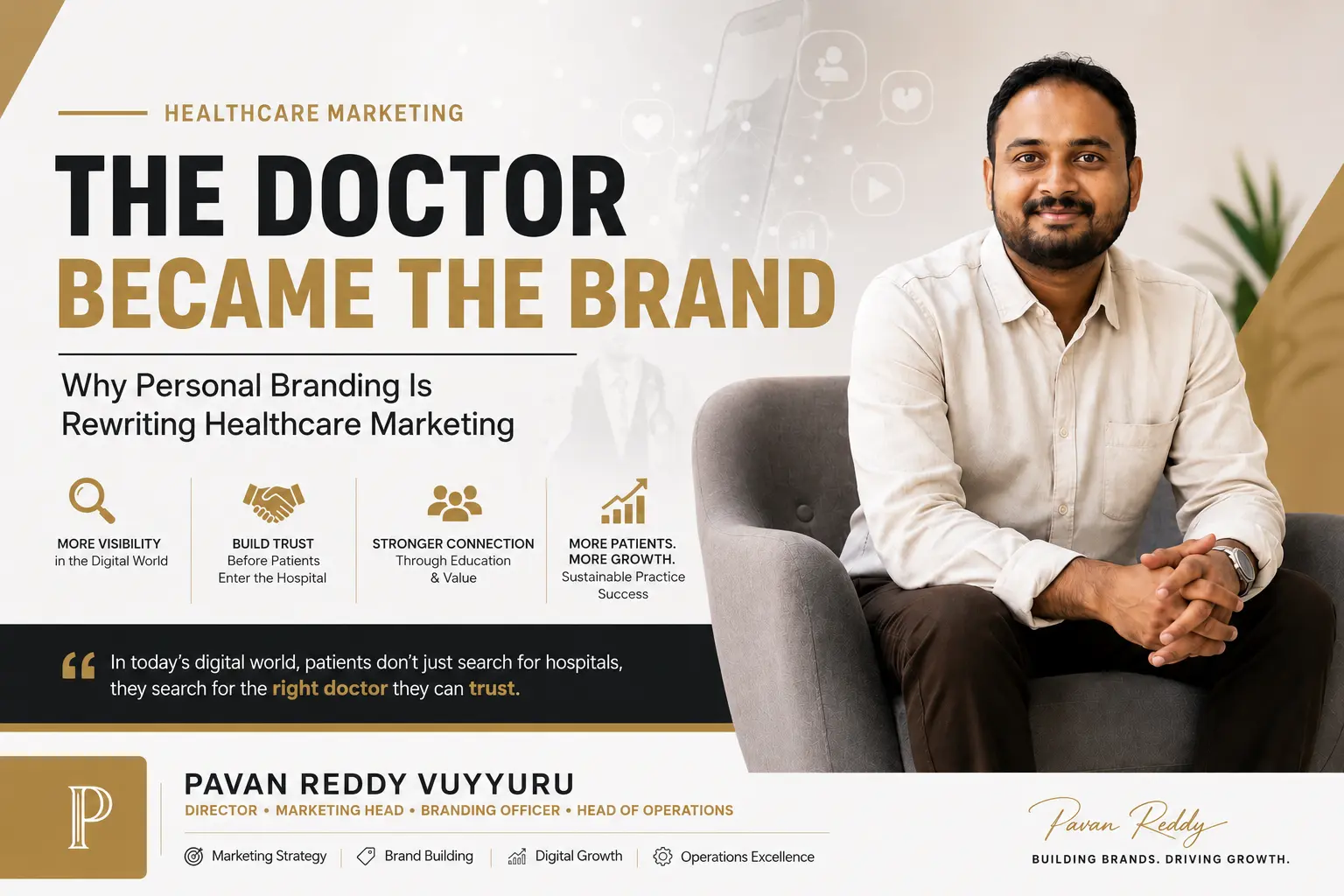
The Doctor Became the Brand

Why Personal Branding Is Rewriting Healthcare Marketing
Case Study by Pavan Reddy Vuyyuru
Director • Marketing Head • Branding Officer • Head of Operations
The Day I Realised Hospitals Were No Longer the Biggest Brand in the Room
For decades, healthcare marketing had a fairly simple equation:
Hospital + Big Building + Famous Logo + Senior Doctor = Trust.
Put the hospital name on a billboard, add a photograph of the doctor, throw in a few credentials, and everyone went home happy.
Then Instagram happened.
Then YouTube.
Then Reels.
Then Google started answering questions before patients even thought about calling a hospital.
And suddenly, something interesting happened.
Patients weren’t just searching for hospitals anymore. They were searching for doctors.
“Best cardiologist near me.”
“Doctor for PCOS.”
“Why is my BP suddenly high?”
“Best dermatologist in Hyderabad.”
“Is this chest pain serious?”
And sometimes, even more specifically:
“Dr. ___ reviews.”
That tiny change in search behaviour created a massive shift in healthcare branding.
The hospital was still important.
But the doctor became the destination.
And that, in my view, is one of the most fascinating branding shifts happening in modern healthcare.
From Hospital Brand to Human Brand
Traditional healthcare branding was heavily institution-led.
The hospital invested in:
Infrastructure
Buildings
Technology
Accreditations
Hospital advertising
Outdoor campaigns
Newspaper advertisements
Corporate partnerships
PR
Brand awareness
All of these still matter.
But digitalisation changed one fundamental thing:
People now want to know the person behind the expertise.
A beautifully designed hospital advertisement can tell me that you have 25 departments.
A 60-second video of a doctor explaining why my recurring headache may not be “just stress” can make me trust that doctor.
One is information.
The other is connection.
And in today’s attention economy, connection wins far more often than another beautifully lit hospital building.
The Interesting Part: Even Senior Hospital Doctors Started Building Their Own Brands
This is where the shift becomes particularly interesting.
Personal branding wasn’t initially something people associated with doctors.
It was for:
Entrepreneurs
CEOs
Actors
Influencers
Consultants
Politicians
Coaches
Doctors traditionally had a different equation:
“My qualification is my brand.”
MD.
DM.
MS.
MBBS.
15 years of experience.
Senior Consultant.
Department Head.
Done.
But the internet doesn’t work that way.
The internet doesn’t automatically reward qualifications.
It rewards visibility, consistency, credibility and relevance.
A doctor can have 20 years of experience.
But if another doctor with five years of experience is consistently answering patient questions online, appearing in educational videos, publishing useful content and becoming recognisable across Google, Instagram and YouTube…
Guess who the patient remembers?
Exactly.
The internet has an uncomfortable habit of making visibility measurable.
Why Patients Started Following Doctors Instead of Hospitals
There is a psychological reason behind this.
People don’t emotionally connect with institutions as easily as they connect with people.
Nobody wakes up in the morning thinking:
“I really admire Hospital X’s orthopaedic department.”
But they might say:
“I watched Dr. Ravi’s video yesterday. He explained knee pain in a way I finally understood.”
That’s branding.
Not because the doctor shouted:
“I AM A BRAND.”
But because the audience repeatedly experienced value from that person.
And gradually:
Awareness → Familiarity → Trust → Preference → Consultation
That is the personal branding funnel I find particularly powerful in healthcare.
Social Media Turned Doctors Into Educators
This is perhaps the biggest transformation.
Earlier, a patient generally interacted with a doctor when they had already entered the healthcare system.
Today, the interaction can begin months before the appointment.
A doctor can answer questions such as:
Why does acidity keep coming back?
When should you worry about chest pain?
Is hair fall always hormonal?
Why does your child keep getting allergies?
What does high cholesterol actually mean?
When is surgery really necessary?
What symptoms should never be ignored?
The patient may not book an appointment immediately.
That’s okay.
Because branding isn’t always about immediate conversion.
Sometimes the job is simply:
“Be the doctor they remember when the problem becomes real.”
That is an extremely powerful form of brand recall.
Personal Branding Became a Business Strategy — Not Just an Ego Project
There is a misconception that personal branding is about becoming famous.
It isn’t.
At least it shouldn’t be.
For a doctor, personal branding can contribute to a much larger business ecosystem.
1. Increased Awareness
More people discover the doctor beyond the hospital’s existing audience.
2. Higher Trust
Consistent educational content demonstrates expertise before the first consultation.
3. Stronger Recall
When a healthcare problem occurs, the doctor is already familiar to the audience.
4. More Patient Enquiries
Content creates opportunities for people to initiate consultations.
5. Better Footfall
When awareness and trust increase, the probability of patients choosing that doctor can increase as well.
6. Revenue Growth
More qualified consultations can eventually translate into stronger practice economics.
7. Professional Authority
The doctor becomes known for a specific area of expertise rather than simply being another name on a hospital website.
8. Long-Term Brand Equity
Most importantly, the brand travels with the doctor.
The hospital may change. The personal brand stays.
And that changes the economics of reputation.
The Hospital Still Matters. But the Relationship Is Changing.
This isn’t an argument against hospital branding.
Far from it.
A strong hospital brand provides:
Infrastructure + Trust + Technology + Systems + Patient Experience
A strong doctor brand provides:
Expertise + Personality + Authority + Familiarity + Connection
Put both together and you get something considerably more powerful.
Hospital Brand
“Here is what our institution can provide.”
Personal Brand
“Here is who I am, what I know, and how I can help.”
The smartest healthcare organisations aren’t necessarily choosing one over the other.
They’re learning how to make both work together.
The New Healthcare Marketing Flywheel
What I increasingly see is a cycle that looks something like this:
Educational Content
↓
Audience Attention
↓
Doctor Recognition
↓
Trust
↓
Search & Enquiries
↓
Consultation
↓
Patient Experience
↓
Reviews & Word of Mouth
↓
More Digital Visibility
↓
More Trust
And the wheel keeps turning.
The beautiful part?
A single useful video can continue working long after the doctor has gone home.
A billboard disappears when the campaign ends.
A useful YouTube video can keep answering questions for years.
That’s the difference between advertising and digital brand assets.
Fame Is Not the Goal. Familiarity Is.
This is another important distinction.
A doctor doesn’t necessarily need millions of followers.
10 million views sound impressive.
But if those views come from people who will never become relevant patients, they are mostly vanity metrics.
I’d rather have:
50,000 relevant people who genuinely trust the doctor
than
5 million random views with zero business relevance.
For healthcare personal branding, I would prioritise:
Relevance > Reach
Trust > Virality
Consistency > Occasional Fame
Patient Intent > Vanity Metrics
Because ultimately, the objective isn’t to make a doctor an influencer.
The objective is to make the doctor the first name people remember when they need that expertise.
The Rise of the “Searchable Doctor”
This is where SEO enters the picture.
Personal branding and SEO are becoming increasingly interconnected.
A doctor today should not only be visible on Instagram.
They should ideally have a strong digital footprint across:
Google Search
Google Business Profile
YouTube
Instagram
Facebook
LinkedIn
Hospital profiles
Medical directories
Interviews
Articles
Podcasts
Educational content
Why?
Because patients don’t live on one platform.
Someone might discover a doctor through Instagram.
Then search them on Google.
Watch a YouTube video.
Read reviews.
Check qualifications.
Look at the hospital.
And finally book an appointment.
The patient journey has become a multi-platform investigation.
And healthcare brands need to understand that.
What Changed From Traditional Marketing?
OLD MODEL
Hospital advertises → Patient sees → Patient remembers hospital → Patient chooses doctor.
NEW MODEL
Patient searches → Discovers doctor → Consumes content → Builds familiarity → Checks credibility → Searches reviews → Evaluates hospital → Books consultation.
The interesting part is that the doctor can now influence the journey before the hospital enters the conversation.
That is a major strategic shift.
Personal Branding Also Solves a Human Problem
Doctors spend years learning medicine.
Patients don’t speak medicine.
They speak:
“Why am I feeling like this?”
“Should I be worried?”
“Is this normal?”
“Do I need surgery?”
“What should I do next?”
The doctor who can translate complicated medical knowledge into simple, understandable communication has a massive advantage in the digital world.
Not because they’re necessarily better doctors.
But because they have become better communicators of their expertise.
And communication is becoming a competitive advantage.
The Doctor’s Name Is Becoming a Digital Asset
This is probably the biggest takeaway from this shift.
A hospital can spend crores building infrastructure.
A doctor can spend years building expertise.
But personal branding creates something different:
Digital Equity.
Every:
Video
Article
Interview
Review
Podcast
Educational post
Search result
Patient interaction
Media mention
adds another layer to the doctor’s digital identity.
Over time, the doctor’s name itself starts carrying meaning.
“If I have this problem, I know whom to consult.”
That’s when a personal brand has actually been built.
Where I See the Biggest Opportunity
From a brand management perspective, I don’t think healthcare personal branding should stop at posting three reels every week.
That’s content management.
Personal branding is much bigger.
It should answer:
What should this doctor be known for?
Who should know them?
Why should patients trust them?
What questions should they own online?
What category should their name dominate?
What personality should the brand communicate?
What patient journey should the digital ecosystem create?
And most importantly — how does all of this connect back to the business?
Once you start asking those questions, you’re no longer “handling social media.”
You’re building a personal brand architecture.
My Perspective as a Branding Head
Working across brand management, digital marketing, social media, SEO, website strategy, content, paid advertising and growth, I’ve learned that branding isn’t about making something look good.
That’s the easy part.
The difficult part is making the brand mean something.
Healthcare is particularly interesting because trust is not optional.
You can buy attention.
You can buy impressions.
You can run advertisements.
But you cannot simply buy genuine credibility.
You have to build it.
And that’s why I believe the rise of doctor personal branding is not merely a social media trend.
It is a structural change in how healthcare brands are discovered, evaluated and remembered.
The Future: Hospital + Doctor + Digital Brand
I don’t believe hospitals are going away.
I don’t believe personal branding will replace institutional branding.
I believe the future belongs to healthcare organisations that understand the relationship between both.
The hospital becomes the ecosystem.
The doctor becomes the human connection.
Digital becomes the distribution engine.
Content becomes the education layer.
SEO becomes the discovery layer.
Reviews become the social proof.
And patient experience becomes the ultimate brand campaign.
Because at the end of the day, the most powerful healthcare marketing strategy is still incredibly simple:
Help people.
Then make sure the right people know that you help them.
The Real Shift
Healthcare marketing used to ask:
“How do we make people remember our hospital?”
The modern question is becoming:
“How do we make people remember the right doctor, for the right problem, at the right moment?”
That is a very different marketing problem.
And a much more interesting one.
The doctor is no longer just a professional listed under a hospital department.
The doctor is becoming a media brand, an educator, a trusted voice and a searchable authority.
Not because doctors suddenly wanted to become celebrities.
Because patient behaviour changed.
And whenever consumer behaviour changes, branding has to change with it.
My Takeaway
The future of healthcare branding won’t belong exclusively to the hospital with the biggest building.
It will belong to the healthcare brands that can combine:
Institutional Trust + Doctor Authority + Digital Visibility + Patient Experience.
And for doctors, personal branding isn’t about becoming famous for the sake of fame.
It is about becoming recognisable for the right reasons.
To educate.
To build trust.
To answer questions.
To reach people before they reach the hospital.
To create stronger patient relationships.
And yes—
to build a sustainable professional and business brand around years of hard-earned expertise.
Because in today’s digital world, being an excellent doctor is one thing.
Being discoverable as an excellent doctor is a completely different game.
And the doctors who understand that difference early will have a very interesting advantage.
About the Author
Pavan Reddy Vuyyuru is a Brand Manager and Digital Marketing Strategist specialising in brand strategy, personal branding, social media marketing, SEO, website strategy, content marketing, paid advertising and business growth.
His approach sits at the intersection of branding, technology, digital behaviour and business growth—with a focus on turning visibility into meaningful brand equity and measurable business outcomes.
Pavan Reddy | Pavan Sai Reddy Vuyyuru